Order of the Shattered Throne
Conclave of the Spheres
Legion of the Fallen
Primal Blood
Legion of the Fallen
Artisans of Immortality
In the southernmost reaches of Selejia, one can find a nation ruled by the living masters of death. Both the living and Fallen inhabitants of Belyos prepare for a new age of the world, when they reach beyond their borders and use their esoteric arts to rescue all from the curse of death.
About the Faction
History
People of the Faction
Magic
When the Everlasting still walked upon Agnar, mortals had already proved they were capable of wondrous feats of magic. Some believed those feats were only possible due to the benevolence of the Everlasting, who illuminated the minds of mortals with their knowledge and skills. There were those, however, who dared tread where even the so-called gods would not, and who proclaimed themselves to be better, their works more beautiful and mighty than those of the Everlasting. Those who bore witness to the flying city of Abysola may have dared to agree.
During the Age of the Everlasting, the people of Belyos strived to better themselves and their world. Their leader, Ptan-Ravalum, was an Everlasting who renounced both her original name and status as a god to humbly guide her people towards enlightenment, as the maestro of a beautiful orchestra. She even fell in love with a human by the name of Kerak and took him as her consort. Although powerful beyond measure, it was Ravalum’s dedication and pride in her people that made them rise to such lofty heights, with their most beautiful creation being the floating city of Abysola. She and her people wished for a world freed from the Curse of Death, where all could revel in the fruits of their labor. It would be a world based on equality where mortals would be liberated from the capricious whims of false gods. The Triumvirate claimed this path was a dangerous one, that mortals wielding such power, without the restraints imposed by the Everlasting, would destroy all. The Belyosans carried on, their blatant defiance a sign of their intent to shatter the status quo. The Triumvirate chose to make an example out of them, and in a single day, a kingdom was destroyed, and another rose from its corpse.
The Triumvirate struck down the floating city of Abysola, killing all of its inhabitants save for Ptan-Ravalum and her three children. Holding the broken body of Kerak, Ptan-Ravalum cried out in vengeful rage. She made him into a Legacy, so that he may remain by her side. It was then that she first used the Anush-Vah, a powerful, if incomplete, magic, expected to be the means of vanquishing the Curse of Death. With mastery over this eldritch art, she awakened an entire city of corpses, defying the will of her treacherous siblings. Swearing to her people that their sacrifice would never be forgotten, she became the first Queen-Priestess of the Legion of the Fallen.
In the years that followed, Ptan-Ravalum guided her subjects to fight against the Triumvirate, but soon found that her Legion of the Fallen took too great a toll on the Anush-Vah. If her people were to survive the trying times to come, her magic would need more. Sacrificing herself, she created the Amatrix, an artifact empowered by her very soul, and a wellspring of power. Now, Legacy and Vestige, lovers once more reunited, sit in judgment of every would-be monarch, denying all who would rule for themselves before the people.
In the south of the continent, the followers of Ptan-Ravalum have rebuilt on and around the ruins of Abysola. Even though their numbers were severely diminished, death couldn’t stop the Legion. The ways of the Anush-Vah have created a new model of society, where death is far from being the end, and where the Legions of the honorable Fallen serve the living.
The Court of Whispers
During the golden age of Abysola, Ptan-Ravalum and her consort sired three children. After their mother’s sacrifice at the height of the Everlasting War, their dispute for the right to rule sparked a civil war that almost tore the Legion of the Fallen apart, as the Amatrix and the Scepter would have accepted any of the three as bearers. For a hundred years, the Legion was broken by the siblings—a division ensured by their progeny in the decades that followed. The war would end only when a descendant took possession of the Scepter, forfeiting their lineage’s right to rule in favor of a different path. Rather, all three families would be held in equal measure when selecting a monarch, with the final word being held only by the Scepter and the Amatrix.
Each of the siblings’ lineages gave birth to several noble families that rule the Legion of the Fallen today. Now, inheritors of great knowledge of the Anush-Vah and of the will of their forebears, these families form the aristocratic council that guides the Legion and its monarch. From these distinguished ranks, the line of succession is created, and only those who truly understand Ravalum’s vision for the future of its people are given a place in the line. Eventually, the monarch is consumed by the power of the Amatrix, and a new King or Queen must be selected. To be the first in this long line of succession is a dangerous position, as the aristocracy of the Legion isn’t above employing murderous schemes to quicken the ascension of their kin.
The Court divides itself into three major political philosophies, each an offspring of the original siblings’ worldviews. The Oskari are the warmongers and expansionists, commanding the armies that both protect and conquer the land. The Ynnashir are austere followers of Ptan-Ravalum, who focus on developing the necromantic arts, so that the Curse of Death may be overcome. Lastly, the Masarin focus on the virtue of self-fulfillment, furthering art and craft in all their endeavors. Most have strayed from Ptan-Ravalum’s teachings, caring more about their personal goals than the good of the faction. This myopic vision has given rise to a culture of political infighting and intrigue.
The Fallen
Most of the population of Belyos is composed of the risen dead in many shapes and forms. The powerful armies of the Legion are made in large part of the corporeal risen, as is the labor force that works the fields, builds the palaces, and maintains the infrastructure. As long as they are commanded by a living general, their numbers can make them an extremely effective army. However, if the knowledge gathered during their lives is more useful than their physical skills, they are taken to the Epitaph, a library of corpses, where their wisdom may be preserved.
The farther one wanders from the capital, the more they see that shades and spirits also populate the cold south. In desolate places such as the Umberlands, these souls wander in a state of unrest, begging for the living to hear their plight, attacking them when they refuse to listen.
They gain form regardless of a necromancer’s actions. While spirits can coalesce into existence from the souls of the dead almost anywhere, such as the oathbound Revenants of the Order and the gruesome Tragedies commanded by the Legion, they do so much more frequently within Belyos, where the influence of the Amatrix is strongest.
The Power of Anush-Vah
The Anush-Vah is the magic tradition created by Ptan-Ravalum, intended to end the Curse of Death by manipulating a powerful part of every living being: the Soulbreath, the force that animates the body and leaves us when we draw our last breath. Death corrupts this force, and it quickly decays until there’s nothing left. Its manipulation, first achieved by Ptan-Ravalum to raise an army from the ruins of Abysola, is the way the necromancers of Belyos manage to reanimate any dead carcass. Some creatures can be reanimated more easily than others. The longer one has been dead for, the harder it is for the necromancer to raise them again, and the process is never perfect. The necromancers channel the Soulbreath from the environment and use it to reanimate corpses, but the process is akin to trying to unspill a bottle of wine.
Each noble family holds expertise in specific variations of the necromantic arts, passed from generation to generation as deeply guarded secrets. This secret knowledge is what gives them power, both political and practical. There are those who bargain with spirits, who can understand their maddened wails and bind them to service. Others serve as generals, leading great numbers of the mindless Fallen, and others who can demand the dead to tell their tales, recovering secrets long buried in rotten flesh.
To manipulate the Anush-Vah is to deal in entropy. Just as a necromancer can slow it down to preserve a Fallen, so can they hasten it to bring harm and decay. By forcing Soulbreath foreign to the vital energy of an enemy into their body, the hexing process begins. In living organisms, a hex erodes the life force, causing the flesh to burn cold as it sloughs off the bone. Not even stone, metal, or dead flesh are immune to the forces of entropy and can be forced to decay to dust. In small doses, these hexes can be used to torture, rather than kill, a common practice in Belyosan prisons. The Soulbreath can also be manipulated for more subtle effects. Some necromancers can use this energy to contaminate the minds of their enemies, causing them to run or freeze in fear. The more skilled Cursemasters can even control their victims as they would a Fallen.
The closer a necromancer is to the capital city of Abysola, the easier it is to manipulate the AnushVah. Powerful Seekers and necromancers can bend the Soulbreath to their will in any place of Selejia. However, the aura that emanates from the Amatrix makes the Soulbreath more malleable than usual and prevents its decay. The reach of the Legion of the Fallen is therefore limited by the Amatrix’s range of influence, a deficiency the necromancers seek to overcome by enhancing the inheritance of Ptan-Ravalum with the power of Relics. One day, the Legion will reach out to the rest of Selejia, offering to free them from the Curse of Death.
The Seekers
The Malediction holds secrets untold, and only a Seeker may uncover them. Join the ranks of the brave few who dare face death.

Vorendal, The Dreadheart
Rumors abound in the Court of Whispers about Lord Stevas Vorendal, the Dreadheart. He has been “alive” since the Age of Strife, serving the Legion in one way or another. Some say he’s the embodiment of the Legion’s goals, one who has defeated death; others see in him a threat, one of the Fallen, daring to command the living. All this speculation is answered by Vorendal with a sinister grin.
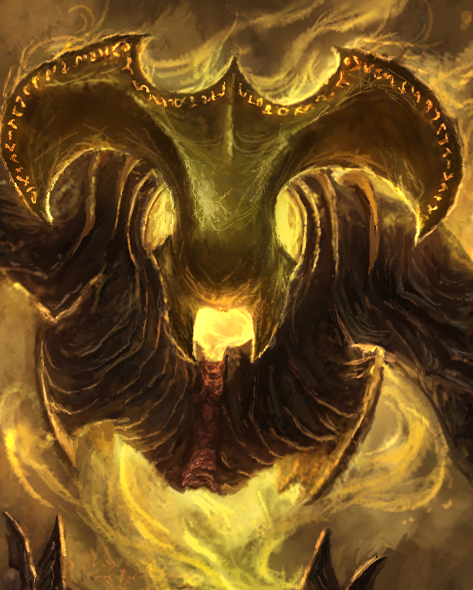
Griza, Lingering Wound
Every faction in Selejia has its own beliefs about what happens after one's death. However, people had never before seen a manifestation that held features from more than one form of afterlife… Until Griza made their mark in the Malediction.

In’Gor, The Spiritbound
The In'Grok dynasty is but a shadow of its former glory, and its heir, In'Gor, the Spiritbound, will not rest until he sees the Primal Blood united under his banner. With his body possessed and warped by foul spirits, many thought In’Gor to be done for, but he refuses to give in, for his agony is a small price to pay to achieve his grand vision.


